My New Mobile Phone
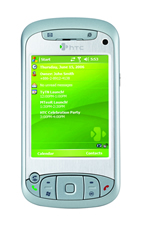
I have a new (smart)phone!
I have also a new cellular number.Just call my previous number and you will find a message announcing the new number :-)
Happy new year to everybody!
staccato signals of constant information
Fight spam, please, do NOT publish this (above) address --INSTEAD publish a link to this blog, i.e.
"http://lasers-in-the-jungle.blogspot.com"
I have a new (smart)phone!
I have also a new cellular number.Just call my previous number and you will find a message announcing the new number :-)
Happy new year to everybody!
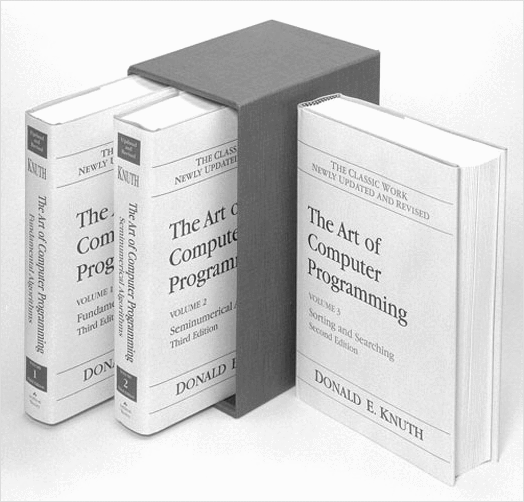
Letter to the Patent Office
From Professor Donald Knuth
Commissioner of Patents and Trademarks
Box 4
Patent and Trademark Office
Washington, DC 20231
Dear Commissioner:
Along with many other computer scientists, I would like to ask you to reconsider the current policy of giving patents for computational processes. I find a considerable anxiety throughout the community of practicing computer scientists that decisions by the patent courts and the Patent and Trademark Office are making life much more difficult for programmers.
In the period 1945-1980, it was generally believed that patent law did not pertain to software. However, it now appears that some people have received patents for algorithms of practical importance--e.g., Lempel-Ziv compression and RSA public key encryption--and are now legally preventing other programmers from using these algorithms.
This is a serious change from the previous policy under which the computer revolution became possible, and I fear this change will be harmful for society. It certainly would have had a profoundly negative effect on my own work: For example, I developed software called TeX that is now used to produce more than 90% of all books and journals in mathematics and physics and to produce hundreds of thousands of technical reports in all scientific disciplines. If software patents had been commonplace in 1980, I would not have been able to create such a system, nor would I probably have ever thought of doing it, nor can I imagine anyone else doing so.
I am told that the courts are trying to make a distinction between mathematical algorithms and nonmathematical algorithms. To a computer scientist, this makes no sense, because every algorithm is as mathematical as anything could be. An algorithm is an abstract concept unrelated to physical laws of the universe.
Nor is it possible to distinguish between "numerical" and "nonnumerical" algorithms, as if numbers were somehow different from other kinds of precise information. All data are numbers, and all numbers are data. Mathematicians work much more with symbolic entities than with numbers.
Therefore the idea of passing laws that say some kinds of algorithms belong to mathematics and some do not strikes me as absurd as the 19th century attempts of the Indiana legislature to pass a law that the ratio of a circle's circumference to its diameter is exactly 3, not approximately 3.1416. It's like the medieval church ruling that the sun revolves about the earth. Man-made laws can be significantly helpful but not when they contradict fundamental truths.
Congress wisely decided long ago that mathematical things cannot be patented. Surely nobody could apply mathematics if it were necessary to pay a license fee whenever the theorem of Pythagoras is employed. The basic algorithmic ideas that people are now rushing to patent are so fundamental, the result threatens to be like what would happen if we allowed authors to have patents on individual words and concepts. Novelists or journalists would be unable to write stories unless their publishers had permission from the owners of the words. Algorithms are exactly as basic to software as words are to writers, because they are the fundamental building blocks needed to make interesting products. What would happen if individual lawyers could patent their methods of defense, or if Supreme Court justices could patent their precedents?
I realize that the patent courts try their best to serve society when they formulate patent law. The Patent Office has fulfilled this mission admirably with respect to aspects of technology that involve concrete laws of physics rather than abstract laws of thought. I myself have a few patents on hardware devices. But I strongly believe that the recent trend to patenting algorithms is of benefit only to a very small number of attorneys and inventors, while it is seriously harmful to the vast majority of people who want to do useful things with computers.
When I think of the computer programs I require daily to get my own work done, I cannot help but realize that none of them would exist today if software patents had been prevalent in the 1960s and 1970s. Changing the rules now will have the effect of freezing progress at essentially its current level. If present trends continue, the only recourse available to the majority of America's brilliant software developers will be to give up software or to emigrate. The U.S.A. will soon lose its dominant position.
Please do what you can to reverse this alarming trend. There are far better ways to protect the intellectual property rights of software developers than to take away their right to use fundamental building blocks.
Sincerely,
Donald E. Knuth
Professor Emeritus
Links:
http://lpf.ai.mit.edu/Newsletter/programming.freedom.11.html
http://lpf.ai.mit.edu/Patents/knuth-to-pto.txt
http://www.pluto.it/files/meeting1999/atti/no-patents/brevetti/docs/knuth_letter_en.html
http://en.wikipedia.org/wiki/The_Art_of_Computer_Programming
http://en.wikipedia.org/wiki/Donald_Knuth
http://www-cs-staff.stanford.edu/~knuth/
http://www.digital-copyright.ca/discuss/1104
http://swpat.ffii.org/gasnu/knuth/swpatknuth.en.pdf
http://swpat.ffii.org/gasnu/knuth/index.en.html


Those pictures are from the public presentation of a book, a friend of mine wrote.
Not it first book, but only one and half year after the first.
link:
http://www.pedepagina.pt/gato8.htm
http://lasers-in-the-jungle.blogspot.com/2005/05/book-presentation.html
UPDATE:
Satellite Photo:
http://maps.google.com/maps?f=q&hl=en&q=38.746649,-9.18275&ie=UTF8&z=17&ll=38.746645,-9.182746&spn=0.004192,0.013497&t=k&om=1&iwloc=addr
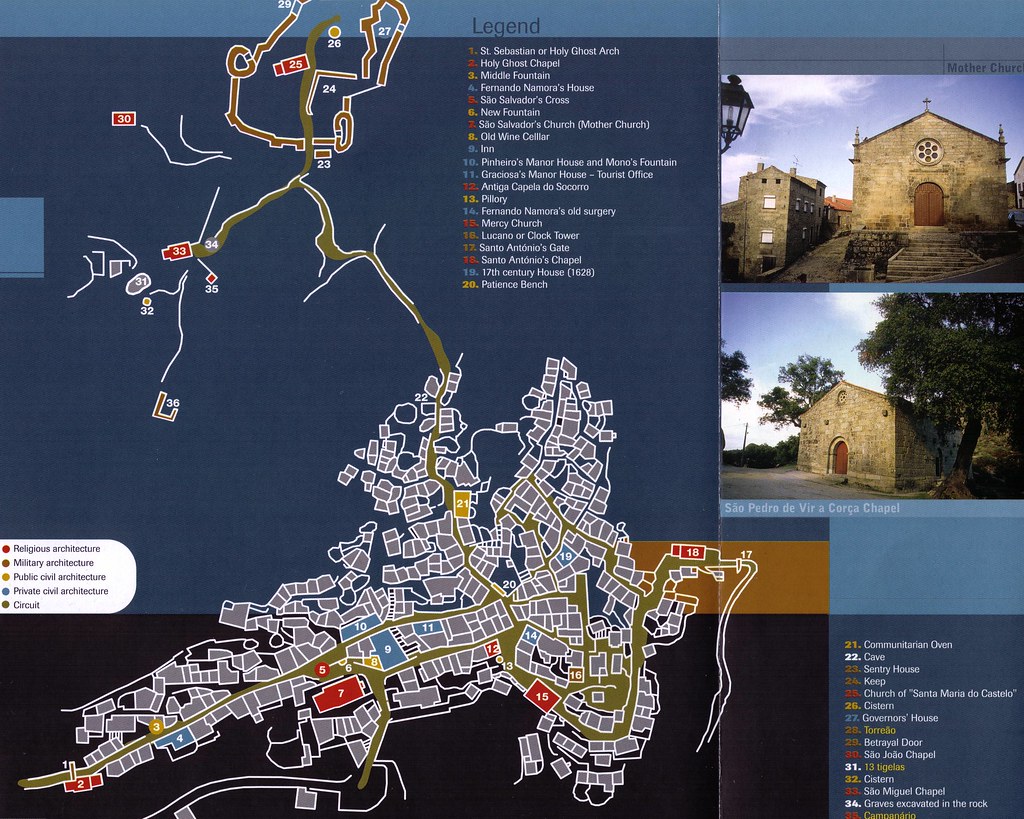
(aka Lucan’s Tower)

The location can be seen in a map recently publish in this blog, in
http://lasers-in-the-jungle.blogspot.com/2006/12/monsanto.html [look for number 19!]
some links:
http://en.wikipedia.org/wiki/Monsanto_%28Idanha-a-Nova%29
http://viajar.clix.pt/com/tesouros.php?id=513&lg=en
http://www.golisbon.com/portugal/cities/monsanto.html
http://maps.yahoo.com/broadband/#mvt=m&trf=0&lon=-7.115493&lat=40.045325&mag=4
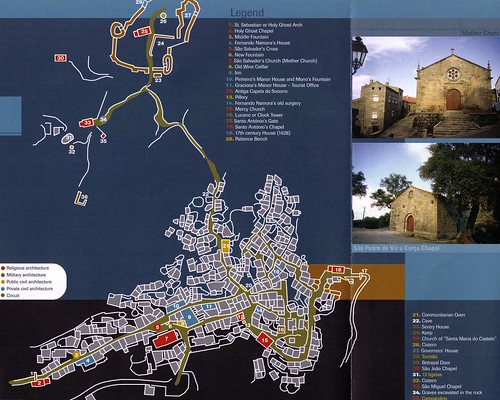
(high resolution version)
Although in a governmental publication about one of the most publicised tourist destination, the map does does not have a "compass rose", not even a "north symbol". And no scale too.
So it is very difficult to compare it with other map(s).
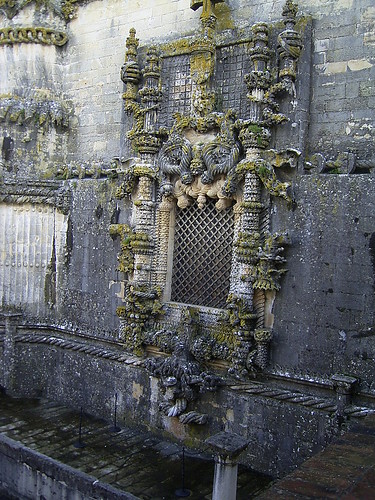
Manueline Window of the Chapter House of the nave of the Convent church
Links:
http://en.wikipedia.org/wiki/Convent_of_the_Order_of_Christ
http://whc.unesco.org/en/list/265
I have lived in this house, for a month, back in August 1975 (Agosto de 1975, 1975 hot summer)
I have never return, until yesterday. Driving in the nearby E802/A23/IP2 highway I decided to take a 12 kms detour and take this picture.
All the place was changed, as you might as well guess, but I managed to find the spot.
BUT from the picture we can see that the house has been VERY closed to be consumed by fire very recently. We can see burned trees as far as 10 meters.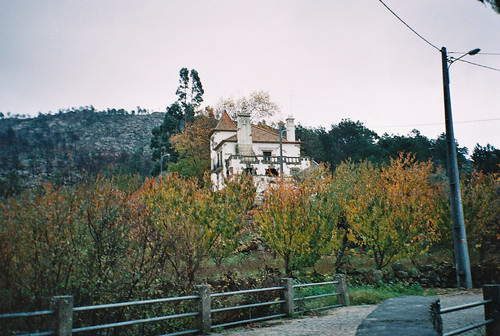
Satellite photo of the house:
http://maps.google.com/maps?f=q&hl=en&q=40.05653,-7.53219&ie=UTF8&z=18&ll=40.056001,-7.53381&spn=0.002037,0.006748&t=k&om=1
P type geographic features
populated place
a city, town, village, or other agglomeration of buildings where people live and work
Louriçal do Campo (1.4Km)
Torre (1.4Km)
São Fiel (3.4Km)
São Vicente da Beira (3.4Km)
Casal da Fraga (3.4Km)
Paradanta (4.6Km)
Soalheira (4.6Km)
Pereiros (4.6Km)
Castelo Novo (4.7Km)
Vale de Urso (5.6Km)
Barroca do Mercado (6.2Km)
Sobral do Campo (6.2Km)
Partida (7.1Km)
Vale de Figueiras (7.3Km)
Souto da Casa (7.6Km)
Alpedrinha (8Km)
Enxabarda (8Km)
Mourelo (8Km)
Alcangosta (8.6Km)
Catraia e Candais (8.6Km)
H type geographic features
stream
a body of running water moving to a lower level in a channel on land
Ribeira de São Vicente (3.4Km)
Ribeiro da Partida (6.8Km)
Ribeira das Enguias (7.1Km)
Ribeira da Enxabarda (8.6Km)
Ribeiro da Borralheira (8.6Km)
Ribeiro do Mioso (8.6Km)
T type geographic features
mountain
an elevation standing high above the surrounding area with small summit area, steep slopes and local relief of 300m or more
Alto da Praça (5.7Km)
mountains
a mountain range or a group of mountains or high ridges
Serra da Guardunha (4Km)
A type geographic features
first-order administrative division
a primary administrative division of a country, such as a state in the United States
Distrito de Castelo Branco (6.2Km)
second-order administrative division
a subdivision of a first-order administrative division
Concelho do Fundão (9.7Km)
S type geographic features
abandoned railroad station
Castelo Novo (6Km)
My professional email is malfunction, for the last 4 or 5 days.
Also my mobile phone is not working for 2 weeks (I got the recorded messages through the Internet....)
If you send-me me something important in the last 2 weeks, please send it again
The email of this blog is OK (see in the headers...) USE IT
Also: help me choose a new mobile phone
(details: http://wifi-pda-phone.blogspot.com )

...Mohammed sees women strung up by hooks thrust through their tongues by a green demon. Their crimes were to "mock" their husbands and to leave their homes without permission. Persian, 15th century

Not a GREAT show, I am afraid.
Interesting:
http://en.wikipedia.org/wiki/Black_drop_effect
http://www.aas.org/publications/baas/v35n5/aas203/26.htm
http://sunearth.gsfc.nasa.gov/eclipse/OH/transit06.html
UPDATE: But a good day to discuss the results of the american elections


I saw this billboard in the L'Enfant Plaza metro station, in Washington. A few dictionaries and encyclopedias latter I haven't figure out yet the meaning of the word "score" in this context.
Satellite Photo:
http://maps.google.com/maps?f=q&hl=en&q=38.88390,-77.024964&ie=UTF8&om=0&t=k&z=17&ll=38.883901,-77.024964&spn=0.004126,0.013475
(
a photo of the Lincoln Memorial - and link to the Satellite Photo - is here:
http://lasers-in-the-jungle.blogspot.com/2006/09/my-chronicles-from-sprawl-15n.html
)
UPDATE:
"A group of twenty units is often referred to as a score"
cf. http://en.wikipedia.org/wiki/20_(number)


As can be seen from the pictures is very difficult to confirm with seismological data explosions below 2 kt even with close seismic stations. Seismology easily estimate the magnitude of the explosion/earthquake, but not its nature. Morever good results could take a couple of weeks to publish.
Keep in mind that North Korea has an tradition of announcing achievements nobody else managed to see.
(see http://en.wikipedia.org/wiki/Kwangmy%C5%8Fngs%C5%8Fng )
I believe that a small robotic plane, charged with chemical detectors, lunched by the US from S. Korea or from the sea will be able to detect nuclear explosions with less then ONE kt (even if underground).
Saying that I must add that, in my opinion
(a) any exposition below 2 kt (some will say 10kt) is probably a failure because large quantities of chemical explosives (in the range of 10 - 20 t) are typically used in crude devices to detonate the plutonium in the 2kt - 20kt range, except if highly sophisticated technology is available to detonate small amounts of plutonium with small amounts of explosives.
(b) using chemical explosives to simulate a SMALL nuclear explosion is insane, costly and dangerous (but possible). We are speaking of 1-2 kt of conventional explosives that could be coupled with a plutonium device, just in case it works or not, keeping always below seismic decrimination (i.e. 1 - 2kt)
(c) China in between a rock and a hard place. If it supports Pyongyang, as it usually does, Taiwan will have a REALLY nuclear bomb in less then 2 years (Japan, South Korea and the Republic of China could develop a fission bomb in less then 6 months, including lunching capacity).
(d) In 2 weeks those matters would be much more clear.
more links:
http://en.wikipedia.org/wiki/Nuclear_weapon
http://en.wikipedia.org/wiki/2006_North_Korean_nuclear_test
http://en.wikipedia.org/wiki/North_Korea_and_weapons_of_mass_destruction
http://en.wikipedia.org/wiki/2006_North_Korean_nuclear_test

Don't be fooled by the picture, the crater, known as "Victoria Crater" is approximately 750 meters wide (about 7 football fields) and 70 meters (the height of a 20 stories building) deep.