Two Thousand People, May be More (I - The Gathering)

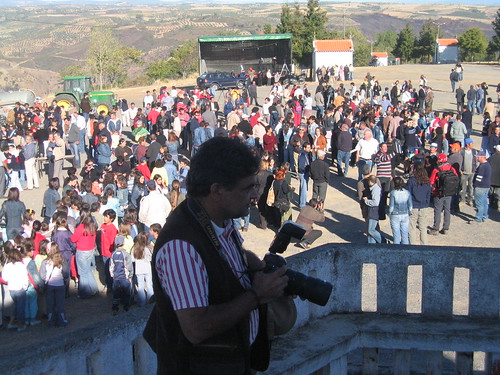
Last October the 3rd I was in the S. Bartolomeu (Bartholomew) Hill (41.66178N, 6.63081W, 728m, WGS84) where around two thousand people gather to see the (Sun) annular eclipse.
staccato signals of constant information
Fight spam, please, do NOT publish this (above) address --INSTEAD publish a link to this blog, i.e.
"http://lasers-in-the-jungle.blogspot.com"
Last October the 3rd I was in the S. Bartolomeu (Bartholomew) Hill (41.66178N, 6.63081W, 728m, WGS84) where around two thousand people gather to see the (Sun) annular eclipse.
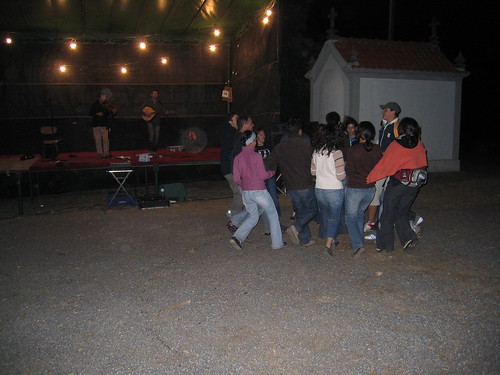

Some people came a couple of days before. In the night a few
danced at the sound of Celtic music.
Physics for future-biologists or future-physicians who what to learn the least possible of physics, but still menage to finish university.
This text is free for everybody to use under the “Attribution + ShareAlike” Creative Commons license.
See http://lasers-in-the-jungle.blogspot.com/2008/06/attribution-sharealike.html
Part1 - INTRODUCTION
Introduction 1 – modern physics
Q) What is “modern physics”
A) It's the physics developed in the XX and XXI centuries
Q) What are the highlights of modern physics
A) “quantum mechanics” and “relativity”
Q) quantum mechanics and relativity are easy subjects?
A) No, they are difficult. They are usually only taught at physics courses
Q) What else important brought us modern physics?
A) The modern concept of “atom” and its inside, i. e. “atomic physics” (or “atom physics”) and “nuclear physics”.
Q) What the name of physics that is not modern physics?
A) Classical physics
Introduction 2 - frequency
Q) What is “frequency”?
A) The number of times a phenomenon repeats itself in a unity of time (usually in each second).
Q) What is an hertz (abbreviation: Hz)?
A) The most usual unity of frequency. If something repeats itself twice each second, we say that it has a 2Hz frequency. Three times a second = 3 Hz, and so on.
Q) Why Hz starts with a capital “H” and hertz does not?
A) Nothing really important there. Just the rules. Please take care that if you are speaking about somebody called Hertz, or about a car rental company called Hertz, you should always use a capital “H”. Once again that just the (grammar) rules.
Q) What is a EHz, PHz, THz, GHz, MHz, kHz ?
A) The letter before Hz is just a short way to write a lot of zeros. There is also a name (prefix) for each case. The prefix is use when we are not using the abbreviation of hertz.
E=18 zeros (prefix: Eta)
P=15 zeros (prefix: Peta)
T=12 zeros (prefix: Tera)
G=9 zeros (prefix: Giga)
M=6 zeros (prefix: Mega) [aka million]
k=3 zeros (prefix: kilo)
so, for example,
1 EHz = 1 000 000 000 000 000 000 Hz = 1 Etahertz
1 MHz= 1 000 000 Hz = 1 Megahertz = 1 million hertz
1 kHz = 1 000 Hz = 1 kilohertz
Q) What is a million
A) 1 000 000. So one million hertz = 1 000 000 Hz = 1 MHz
Q) What is a billion?
A) Run away from that word as hell. In Europe nobody ever agrees with the meaning of a billion.
In the USA a billion is a thousand millions, i. e., 1 000 000 000.
In Europe some (most?) people claim 1 billion is a million of millions, i. e. 1 000 000 000 000.
Introduction 3 – The atom
Q) What are the atoms made of?
A) Electrons, protons and neutrons. Electrons have a negative ( - ) electric charge, protons neutrons have no charge and protons have a positive ( + ) electric charge. Electrons, protons and neutrons are often called “particles” in this context.
Q) How are electrons, protons and neutrons arranged inside an atom?
A) The protons and the neutrons are inside the central part of the atom (the nucleus). They do not move a lot. The electrons circulate around (OUTSIDE) the nucleus in complex orbits.
Q) That is all?
A) No :-). But understanding the true inside of the atom is only possible if you know your quantum mechanics and relativity which is too complex to use were. So let us stick with the simple model describe above. It has to make do.
Q) How many electrons, protons and neutrons, are there inside an atom?
A) Different atoms have different numbers. We have atoms with zero neutrons, but it has to have at least one proton, to be an atom.
Q) And how many neutrons?
A) Usually the number of neutrons is equal to the number protons, so the electric charge of each pair compensates exactly and the atom as an all do not have an electric charge. However the atom can lose one (or more) of its electrons and became positively charged or can gain and extra electron (or more) and became negatively charged.
Q) What is an ion?
A) Is a atom electrically charged as described above.
Q) What is the simplest possible atom?
A) An atom with only one proton in the nucleus and one only electron around it. It's called Hydrogen. It can even lose its only electron and became a positive ion of Hydrogen (with only one proton).
Q) How much do those particle ( electrons, protons and neutrons) weight?
A) The exact amount is not very important now. Just remember that a proton weight the same as a neutron and a electron weight much, much less. In physics we rather speak about the mass of the particles in the atom, but the concept is similar, the masses of the neutron and a proton are similar, and the mass of the electron is much lower.
Q) What is the mass number of an atom?
A) The mass number (A), also called atomic mass number or nucleon number (nucleon is a collective name for neutrons and protons) , is the number of protons and neutrons in an atom.
Q) What is the atomic number?
A) The atomic number (also known as the proton number) is the number of protons found in the nucleus of an atom. It is traditionally represented by the symbol Z.
Q) What is greater, the mass number or the atomic number?
A) The mass number is always greater then or equal to the atomic number, as everybody could figure out, reading carefully the previous lines.
Q) What is an element?
A) Is a chemical substance that can not be found to be composed of other substances. Examples of elements are: hydrogen, carbon, nitrogen, oxygen, iron, gold, helium, uranium, etc.
Q) Is water an element?
A) No because it has been found that is composed of two substances, oxygen (abbreviation: O) and hydrogen (abbrev: H). Remember high school “water = H2O”.
Q) So water is a mixture of oxygen and hydrogen.
A) NO. Water is a compound of oxygen and hydrogen. The difference between mixture and compound is very important, but we would not talk more about that here. That is stuff for chemistry.
Q) At the atomic level, what defines an element?
A) The atomic number. The atomic number can even be use instead of the name of the element. For example the element “carbon” has 6 protons. So it can be called “element 6”, instead of carbon.
Q) Does the mass number describe an element?
A) No. If two atoms have the same atomic number, but different mass numbers it can be considered atoms of the same element, although different atoms.
Q) Confusing. Can you give me an example?
A) Sure. Let´s go back to the hydrogen. The must common form of hydrogen atom is composed of a proton an an electron and it is called hydrogen-1 (it is also called protium, or “light hydrogen”, but forget that, nobody uses that names any more). However it can be found hydrogen in other type of atom, with one extra neutron. That is called hydrogen-2 (also called “deuterium”, or “heavy hydrogen”). Other form of hydrogen is the hydrogen-3 (also called “tritium” or “triton”), with two extra neutrons (i. e. with one proton, two neutrons, in the nucleus).
Q) So, what is meaning of the number in hydrogen-1, hydrogen-2, hydrogen-3 ?
A) The number is the mass number, i. e. , the number of protons + the number of neutrons.
Q) Is there a common name for hydrogen-1, hydrogen-2, hydrogen-3 ?
A) Yes. They are called hydrogen isotopes.
Q) So what is an isotope?
A) Is one the the possible atoms types of a substance. For example, the element hydrogen, can have 3 different type of atoms, hydrogen-1, hydrogen-2, hydrogen-3, all of them can be called hydrogen and are referred as hydrogen isotopes.
Q) So hydrogen-2 is the “element number 2”?. Isn't it?
A) God's gracious NO! Read again the above text! The TWO as in “element n. 2” refers to the element with two protons in the nucleus (which, by the way, is called helium). The hydrogen has always 1 proton in the nucleus, so it is “element n. 1”. However the number of neutrons in hydrogen can vary, been zero in hydrogen-1, one in hydrogen-2 and two in hydrogen-3.
Q) What are the first and last elements?
A) The first element, obviously, in the element hydrogen, which is element n. 1. The last NATURAL element is element n. 92, called uranium.
However men managed to build elements with a mass atomic number greater then 92. Those elements are, of course, artificial, and are also called transuranium elements ( or transuranic elements) since they are “after” the uranium.
The last transuranium element, as far as I know, is the “element n. 122” called “unbibium” (symbol: Ubb) but that is not important because they may as well “build” an atom of “element. n. 123” today.
When I first study this “things” the last transuranium element was “element. n. 104”, called today rutherfordium (but this is not important, just one more example).
Q) Are isotopes common?
A) No. Usually one isotope for each element is common, all other are rare. For example in the oceans of Earth, approximately, if we have 6500 of hydrogen-1 we have 1 atom of hydrogen-2. Hydrogen-3 is even more, much more, rare.
Q) Can we have artificial (men made) isotopes?
A) Yes. Sometimes it is possible to build artificial isotopes even of natural (not man made) elements.
Q) Can you give me an example.
A) My pleasure. Cobalt. Cobalt is the element n. 27, meaning every cobalt atom has 27 protons. Natural cobalt has only one isotope, named cobalt-59 ( an element with only one isotope is called a monoisotopic element, as you could imagine).
However men can create cobalt-60, an artificial isotope of natural cobalt-59. Cobalt-60 is used a lot in medicine and biology, for several purposes (more on that later).
Q) So what's inside a cobalt-60 nucleus.
A) If you have read the previous text you know by now that inside a cobalt-60 nucleus we have 27 protons and 33 neutrons. (27+33=60).
Q) There are not much about electrons in the previous text, isn't it?
A) Yes. Electrons in not very important in what we said, that why this kind of physics is call atomic or NUCLEAR physics (nuclear, from nucleus = no electrons, only protons and neutrons).
However electrons are important in other fields of physics, for example in electricity that belongs to classical physics, not to modern physics (electricity and electron are words of common origin).
Q) What is a nuclide?
a) Is a type of nucleus. The concept is not very different from isotope, since isotopes have different kind of nucleus. We will not use the word “nuclide” a lot in this notes, but someone may like to know (or ask).
Q) What is the atomic mass?
A) Too complex to explain here. Not very different from mass number.
Q) What is the atomic weight?
A) Again: Too complex to explain here. Not very different from mass number (or atomic mass).
Q) I saw a symbol of an element with superscript or subscript (indexes). What do they mean?
A) Although we have always use correct ways to write our text, that is another way to write mass numbers and atomic numbers with superscript or subscript (indexes). The superscript give us the mass number and the subscript give us the atomic number. That is not easy to write superscripts or subscripts in a computer, so I am not using that.
Q) Where can I find a table with the number of electrons/protons/neutrons, mass numbers, atomic numbers, atomic masses atomic weights of each known element.
A) Go to you next library or bookshop and ask for a “periodical table of elements”. We would start from there.
Physics for future-biologists or future-physicians who what to learn the least possible of physics, but still menage to finish university.
This text is free for everybody to use under the “Attribution + ShareAlike” Creative Commons license.
See http://lasers-in-the-jungle.blogspot.com/2008/06/attribution-sharealike.html
Part 3
Q) What is the plural of nucleus?
A) Nuclei.
Q) What is “nuclear fission”?
A) The splitting of the nuclei of atoms into two fragments. Each of the resultant parts has a low mass number and the results are of approximately equal mass (mass number).
Q) What are the principal uses for “nuclear fission”?
A) The nuclear fission of heavy elements, i.e., elements with high atomic number (usually uranium or plutonium) is accompanied by conversion of part of the mass into energy. That is the principle in which is based the nuclear reactors and the atomic bomb (A-bomb).
Q) Are “nuclear fission” and “nuclear splitting” the same thing.
A) Almost. The correct wording is “nuclear fission”, although we could use “nuclear splitting” in colloquial language. However it is correct to use spit when we need a verb. So we would say: in nuclear fission we split (verb) the atom.
Q) Can all elements be subjected to fission?
A) Theoretically yes (except element n.1, hydrogen) but only the fission of elements with atomic number greater then 26 can produce energy (the element with atomic number equal to 26 is called iron). However, on earth, we only use uranium (element n. 92) or plutonium (element n. 94 – yes is a transuranium element, an artificial element).
Q) What are nuclear reactors used for?
A) Usually to produce energy. But also to create various radioisotopes, such as americium-241 for use in smoke detectors, and cobalt-60, molybdenum-99 and others, used for imaging and medical treatment, has we have seen before. Some nuclear reactors based in uranium also produce large amounts of plutonium.
Q) Are nuclear reactors the only way to produce radioisotopes?
A) No, they can also be made using accelerators (particle accelerators).
Q) What is “nuclear fusion”?
A) It is the fusion of atomic nuclei into a nucleus with heavier mass number element. Just the opposite of nuclear fission (verb: fuse fused fused)
Q) What are the principal uses for “nuclear fusion”?
A) The nuclear fusion of light elements, i.e., elements with low mass number (usually hidrogen-2 and/or hidrogen-3) is accompanied by conversion of part of the mass into energy.
The energy produced is enormous, but mankind has not yet learned how to use it as a source of usable energy. However the principle is used to build hydrogen bombs (H-bombs) that are usually much more powerful that A-bombs. (the exact mechanism of H-bombs is a well guarded secret).
Our Sun, at this moment, produces its energy fusing hydrogen into helium.
Q) Can all elements be subjected to fusion?
A) Theoretically yes but only the fusion of elements with atomic number less then 26 can produce energy (the element with atomic number equal to 26 is called iron). However on earth we only fuse hydrogen, and only by a very short period of time.
Q) What about element n. 26 (iron)? Can it be used on fission or fusion?
A) No. It is a special element on that regard. It can be split or fused, but no energy is produced in the process.
Q) What about the famous Einstein equation E=mc2?
A) It explains the conversion of mass to energy, both in fission and fusion.
Q) What is c2? (read: c-squared)
A) The square of the velocity of light in the vacuum.
Q) What is the velocity of light in the vacuum?
A) 300 000 000 m/s
Q) That is the visible light?
A) Not only. Every form of light, visible or not visible, propagates in the vacuum at the same velocity.
Q) What is a telescope?
A) Is an instrument composed, mainly, of lenses and/or mirrors, that allows people to see distant objects, that could not be seen with a naked eye.
Q) How important was the telescope for the start of “modern science” in XVI and XVII centuries?
Q) Our knowledge of the universe had remained quit constant (and WRONG) since the Greek civilization. The possibility open by the use of the telescope by Galileo, allowed us a much more detailed view of stars and planets, and was the fundament of changing our view of the solar system from a geocentric view (with earth at the center), held by ancient Greek and Chinese astronomers, to a heliocentric view (with the sun at the center) which is the modern concept.
Q) Can you explain in more detailed the construction of the telescope?
A) No. There are hundreds of different types of telescope using different types of lenses and different types of mirrors assembled in diverse ways. Explaining all that will take ages.
Q) Do the telescopes work only with visible light?
A) When we speak about telescopes we are using speaking of optical telescopes, which work with visible light. However there have been built telescopes that work with radio waves (radio telescopes) as well as telescopes working with infrared, telescopes working with X-rays and telescope working with gamma rays. Those are non-optical telescopes and are build in a very different way, if compared with optical telescopes.
Q) What is a microscope?
A) The microscope is similar to a telescope but upside down. Usually only lenses are used (no mirrors). With a microscope we can see small things, not visible at naked eye.
Q) That is the optical microscope (visible light). Isn’t it?
A) Yes. We can also build infrared microscopes, ultraviolet microscopes and X-ray microscopes, which are more complex and we are not going into details.
Q) Other types of microscopes?
A) Yes. More common: “Electron microscopes” and “scanning probe microscopes”. They are the most powerful microscopes and they do NOT use any electromagnetic radiation.
Q) What is “electric current”?
A) Is a flux of electrons flowing through a conductor (conductor: explained latter).
Q) That is “beta radiation”? Isn’t it?
A) No. “Beta radiation” and “electric current” are very different concepts. Although both are “stream of electrons” (yes. Physics is hard).
Q) So can you tell me the difference between “beta radiation” and “electric current”?
A) “Beta radiation” is generated by radioisotopes, fission reactors or particles accelerators. “Electric current” is usually generated by batteries or electrical generators (as used in power generation stations).
This is the same that saying that beta radiation comes from inside the nucleus (yes, I know that we do not have electrons inside the nucleus, however in certain conditions a neutron divides itself into an electron plus a proton...). Beta radiation is nuclear physics.
Electric current comes from disturbing the electrons that orbit the nucleus. That’s classical physics.
Also:
In “beta radiation” the electrons move very fast and are very energetic. Not so in “electric current”.
“Beta radiation” propagates very well in vacuum or in the air, not so well in solids. “Electric currents” do not propagate in vacuum, propagates very hardly in the air (lightning in a thunderstorm) and propagates very well in solids called conductors.
Q) What is, finally, a conductor?
A) Usually conductor is the same of “good conductor” and the opposite of “bad conductor” A conductor is an element or alloy or mixture can that easily conduct “electric current”. A “bad conductor” is usually called an isolator.
Q) Can you give me example of conductors (good conductors)?
A) Yes. Usually metals are good conductors (very used conductors: cooper, iron). But also graphite, which is not a metal, is a very useful conductor.
Q) Is water a good conductor?
A) Pure water is a very BAD conductor. However with something dissolved it can became a good conductor.
Q) What is a superconductor?
A) It is a conductor that is a perfect conductor where the electric current circulates with absolutely no opposition.
Q) Is it easy to obtain a superconductor?
A) Is difficult because known superconductors only operate at very low temperatures. Finding superconductors at room temperature would be a revolution in human society.
Q) Are superconductors important in applied science?
A) Yes. Magnetic Resonance Imaging (MRI) and Nuclear Magnetic Resonance (NMR) are based in superconductivity. Most accelerators are also based in superconductors.
Q) How do we obtain the (very low) temperatures to obtain superconductivity?
A) Using liquid helium
Q) Is easy to manipulate liquid helium?
A) No. Liquid helium is expensive and needs a careful manipulation. However modern equipment can maintain the helium inside with minimum maintenance. Sometimes a “refill” can be needed. Any unexpected escape of helium can be an hazard.
Q) What is a semiconductor?
A) That is the hardest question in this notes :-)
Semiconductors are an essential part of our lives today. Computers, cellular phones, MP3 players, modern radios and televisions, even part of the motors of recent cars are based on “chips” also called “integrated circuits”, “microchips” or “silicon chips”.
A chip is just a complex composition of a very large number of semiconductors (and other elements). Same chips have more then 100 000 000 (an hundred million) semiconductors.
Q) You have not answered my question. What is a semiconductor?
A) Is a material that can, depending of the circumstances, behave like a conductor, behave like an isolator, or behave as something in between. It can sometimes amplificate the (an) electric current.
Q) Which are the simplest devices composed of semiconductors.
A) The transistor and the diode.
Q) What is a transistor?
A) The simplest semiconductor device that can amplify an electric signal.
Q) What is a diode?
A) A device that conduces electricity in one direction but not in the other.
Q) What is “pressure”?
A) Pressure is the force, applied over a surface, divided by the area of that surface. The surface can be real or imaginary. The pressure is measured in pascal (abrev: Pa). a kPa is equal to 1000 Pa. And old unit of pressure is “millimeters of mercury” (Abrv: mmHg, Hg been the chemical symbol of the element “mercury”) another unit is “atmosphere”.
Q) Just one useful exercise, can you calculate the pressure in the base of a column of mercury, 120 mm high?
A) Sure. Let’s see.
Suppose the base is is 1 mm2 (I am writing mm2 as mm-square, because I have problems writing upper-indexes).
The volume is 120x1 = 120 mm3 = 0.120 cm3
The density of the mercury is 13.534 g/cm3 so the mass is 0.120x13.534 = 1.624 g=0.001624 Kg
So the weight (force) is equal to0.001624x 9.8 = 0.01590 N
[Remember p=mg, g=9.8 m/s2]
Pressure = force (weight) / surface
Pressure = 0.01590 N / 1 mm2 = 0.01590 N / 0.000001 m2 = 15900 Pa = 16.9 kPa
Q) What if the surface is NOT 1 mm2?
A) The result is the same. Just try.
Q) What is the other name of mercury?
A) Quick Silver. You should NOT use this name in science. It is an old designation.
Q) What is blood pressure?
A) Is the pressure inside the body, in the blood.
Q) Does the blood pressure vary inside the human body?
A) Yes. It varies with the type of vessels and also varies with the movements of the heart.
Q) How should we measure the blood pressure?
A) I read that we should measure it at an artery. We should identify a maximum and a minimum of the pressure. In the artery. However that should be learned with a specialist not with a physicist.
Q) What are the normal (healthy) human limits?
A) They are 120 mmHg (16 kPa) and 80 mmHg (11 kPa), I read someplace. This is usually called 120-80. The value is very variable with a lost of circumstances very very beyond physics, I just leave this as an example so you have a notion of the values involved.
Q) Which unity should I use to measure blood pressure?
A) That is your choice. Just do NOT mixed up. Probably mmHg is the most used, but perhaps kPa is the future. Now you know how to convert one into the other.
1 kPa = 7.5 mmHg
Q) What is thermodynamics?
A) Is the study of “heat” (thermo) in transit (dynamics).
Q) What is the most obvious “object” of study in thermodynamics?
A) The “internal combustion engine”.
The “internal combustion engine” burns something and gives us energy in the form of movement.
Q) What is an “internal combustion engine”?
A) The “thing” that takes fuel and make my car run.
Q) Can I use the “motor” instead of the word “engine”?
A) Yes, but that may sound a little strange for a native speaker.
The rules are quite confusing, so if you are referring to an “internal combustion engine” use always engine. However a “car” with an “engine” is a “motorcar”. Go figure.
Q) So thermodynamics only applies to engines?
A) No. Although (modern) thermodynamics started studying engines, today it managed to by applied to a lost of disciplines, namely “biology” and “medicine”.
Q) What are the bases of thermodynamics?
A) The five laws of thermodynamics and the concept of “potentials”, Entropy is also an important concept.
Q) What is the most know potential?
A) Enthalpy.
Q) What is “heat”?
A) The everyday life concept is mostly appropriate. Just remember that “heat” is just a form of energy and that “heat” and “temperature” have always different meanings.
Q) What is the difference between “heat” and “temperature”?
A) Just an example. If you have a campfire (outdoor fire) you can have a few people heating themselves around. If you have two similar campfires you double the heat (the double of the people can heat themselves) but the temperature is the same.
Q) Other example please
A) If you can comfortably heat a room with an electrical heater (radiator), you need two similar heaters to heat a biggest room to the same temperature. So the temperature is the same but you have needed the double of heat.
Q) What are the units for “heat” and “temperature”?
A) Heat is a form of energy, so it is measured in joule (abrev: J) as any energy. And old unity may still be in used, is the calorie. 1 calorie = 4.18 J. Calorie is only used in “heat” context.
Q) What is a “big calorie”?
A) 1000 (one thousand) calories.
Q) That is easy. Isn’t it?
A) No because some people abbreviate “big calorie” to “Calorie” (note the capital “C”). So “calorie” and “Calorie” are different things – a mess. Use joule instead.
Q) Could somebody mess up?
A) Do you remember coca-cola adds? Just 1 calorie? Wrong. Just 1 Calorie, 1000 times more.
Q) What about temperature?
A) Temperature is, most of the time, measured in “º” (read: degree) or “ºC” (read: degree-centigrade or degree-Celsius) or just “Celsius”. Aglo-Saxonics also use “degrees Fahrenheit”.
Q) What is absolute temperature?
A) Just add 273.15 to the temperature measured in ºC. The absolute temperature is measured in “º K” (read: degrees-Kelvin).
In physics, most of the times, we use ºK. It is an important conclusion of thermodynamics that we cannot have a temperature bellow 0 ºK (read: zero-degrees-Kelvin).
